


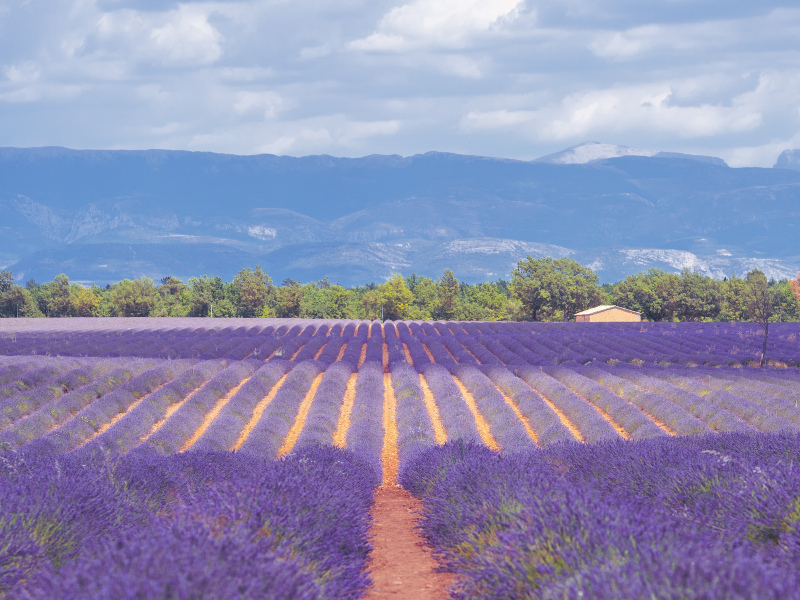
There's a moment, usually somewhere around mid-June, when Provence stops being merely beautiful and becomes something close to absurd. The fields turn purple. The air changes. And roughly ten million people reach for their phones.
We don't blame them. Lavender in full bloom is genuinely one of the great visual spectacles of the natural world, and no photograph - however carefully composed, however golden the light - quite does it justice. But if your experience of lavender country begins and ends with a selfie on the Plateau de Valensole, you've missed most of the story.
Here's how to do it properly.
When does lavender actually bloom?
This is where a lot of visitors come unstuck. Lavender season is shorter than you think, more variable than the tourist brochures admit, and entirely at the mercy of the weather.
The lower-altitude fields - the Luberon, the plateau around Valensole - typically come into bloom from mid-June, with peak colour in late June to early July. The higher you go, the later the season: the plateau around Sault, sitting above 800 metres, holds its colour through late July and sometimes into August.
There's also an important distinction worth knowing. Most of what you see in the big commercial fields is actually lavandin - a hybrid bred for oil yield and visual impact. True lavender (lavande fine) grows at higher altitudes and tends to flower a little later. If you're heading to Sault, you'll find more of the real thing, and a slightly longer season as a result.
One thing the Instagram posts never mention: the farmer decides when to harvest based on oil potency, not visual beauty. In a hot summer, a field can go from full bloom to bare stubble in less than a week. Go earlier rather than later, and always check locally before you travel.
Where to go
The Plateau de Valensole is the classic - rolling fields of purple stretching to the horizon, stone farmhouses, almond trees in the hedgerows. Deservedly famous, and in peak season deservedly busy. Go early in the morning, before the coach parties arrive, and you'll still find magic there. Aim for late June if you can.
Sault is the connoisseur's choice. Perched at altitude in the Vaucluse, it has a longer season, a brilliant lavender festival in mid-August, and a weekly market that overflows with local producers. The landscape around it - wild, sparse, quite different from the manicured Luberon - has a grandeur that's easy to fall for.
Sénanque Abbey, with its lavender terraces framing a Romanesque monastery, is one of those images that has become almost too iconic to see clearly. Go anyway. It earns its reputation.
The Luberon villages - Gordes, Roussillon, Bonnieux - don't have fields at their doorstep, but position you perfectly for day trips into the surrounding lavender country, and offer excellent bases with good restaurants and some of the most beautiful streets in France.
Aix-en-Provence - the perfect base
For many visitors, Aix-en-Provence is the natural starting point for lavender country - and frankly, not a bad place to be stranded if the fields happen to be between their best and the harvest.
Valensole is barely an hour's drive east. The Luberon is on the doorstep. And Aix itself - with its shaded plane-tree boulevards, its daily flower market on the Place de l'Hôtel de Ville, its seemingly inexhaustible supply of good café terraces - is one of those cities that makes you wonder, quite seriously, why you ever live anywhere else.
The morning routine here in lavender season writes itself: coffee on the Cours Mirabeau, a drive out through the Luberon as the light comes up, a walk through violet-scented fields before the heat builds, back to Aix by lunchtime for a long table under the plane trees. There are worse ways to spend a fortnight in June.
Beyond the photograph
The best thing to do in lavender country is slow down. Cycle the back roads when the light is low. Attend a village fête in a Luberon hilltop village in early July. Spend a morning with a local apiculturist and discover what lavender honey actually tastes like when it comes straight from the hive. Visit a distillery and understand why a small bottle of true lavender essential oil costs what it does. Book a table at a farm restaurant and order lamb that has grazed on lavender-scented hillsides its whole life.
And if you really want to go beyond the postcard: come back in autumn. The fields are harvested, the tourists are gone, and the landscape reveals a different, quieter kind of beauty. The light at that time of year in Provence is nothing short of extraordinary.
Staying in lavender country
Aix-en-Provence makes an excellent base - well-connected, beautiful, and with enough to fill any morning when you're not in the fields. From Aix, both Valensole and the Luberon are easy day trips, and the city's restaurant scene means you're never far from a good dinner.
For those who want to be closer to the fields themselves, the Luberon villages are magical but fill up fast in late June and July. Book well ahead, or look at the less-visited villages to the north of the massif - equal beauty, a fraction of the crowds.
A place of your own in Provence
There's a reason so many of our clients find themselves returning to the same corner of Provence year after year until, eventually, they stop returning and simply stay. A restored mas on the edge of the Luberon. A village house in one of the Vaucluse's famous perched villages. A property within easy reach of Aix, with all the city's culture and convenience alongside the space and tranquillity of the Provençal countryside.
The properties in this part of the world have a habit of making people reassess their priorities entirely. If Provence has caught your imagination, we'd be very happy to help you explore what's possible.