


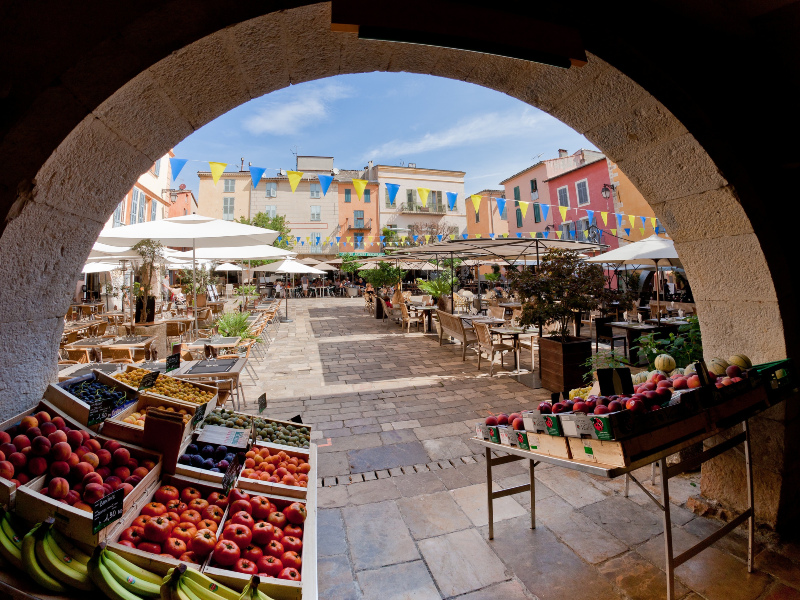
There’s a scene that plays out every week across rural France – in villages and market towns from the Vienne to the Vendée coast, from the Charente to the Corrèze, from the sunlit squares of the Lot-et-Garonne to the bastide towns of the Tarn and the garrigue-scented markets of the Aude – that no supermarket chain has ever quite managed to replicate. By eight in the morning, the vans are already backed up to the square. Trestle tables are going up, awnings are being cranked out, and the first producers are arranging their wares with a care that borders on pride. By nine, the place is alive.
The French weekly market is, of course, nothing new. It has been part of the rhythm of rural life here for centuries. But in a world where the cost of moving food around the planet is becoming harder to ignore, and where global supply chains feel increasingly fragile, the hyper-local food market isn’t just a charming anachronism. It’s beginning to look rather prescient.
The economics of close-to-home
Rising fuel costs, logistical disruption, and the knock-on effects of geopolitical uncertainty have been quietly reshaping the price of food on supermarket shelves across Europe. The further something has travelled – and much of what fills those shelves has travelled a very long way – the more those costs are baked in. Strawberries from Morocco, tomatoes from the Netherlands, lamb from New Zealand: perfectly good produce, but with a carbon footprint and a transport cost that goes up every time something shifts in the world.
At a French marché, the economics look rather different. The maraîcher who sets up his vegetable stall on a Friday morning in Civray or a Thursday in Eymet has, in most cases, driven twenty minutes from his farm. The cheese-maker knows the names of her goats. The duck farmer in the Gers can tell you exactly when the confit was potted. The cheesemaker in the Corrèze has been coming to the same pitch for thirty years. The overheads are low, the supply chain is essentially a van and a market pitch, and the product is as fresh as it’s possible to be.
For buyers watching food prices inch upward, this is not a trivial consideration. It’s one of the quiet, practical arguments for rural French life that often gets overlooked in favour of the more photogenic ones.
What the French have always known
It’s worth saying that none of this is a revelation to the French themselves. The weekly market has never really lost its central place in rural life here the way it did in much of Britain, where the rise of the superstore from the 1980s onwards hollowed out high streets and market days alike. In France, the two have largely coexisted – the supermarché handles the everyday basics, and the market handles everything worth looking forward to.
There’s a social dimension to this that’s harder to put a price on. The market is where you run into your neighbours, where the baker holds back your usual loaf, where the conversation moves from the price of melons to local gossip to who’s selling their house. For anyone arriving from a culture where food shopping has become a largely solitary, screen-lit experience, it can come as something of a jolt – a pleasant one.
A region of extraordinary variety
One of the things that makes the stretch of France in which BVI operates so compelling for food lovers is sheer variety. The territory we cover runs from Poitiers in the north – where the markets of the Vienne draw on some of the finest goat’s cheese country in France – west to the Atlantic coast, where the morning markets at towns like Royan and Saintes brim with oysters and fresh fish. Moving south, the Charente and Dordogne bring their own rich produce traditions: walnut oil, foie gras, truffles in season, and the kind of charcuterie that requires no further explanation.
Further south still, the Lot-et-Garonne earns its reputation as the market garden of France, with the weekly markets at Villeneuve-sur-Lot (Tuesday and Saturday), Agen (Wednesday and Saturday) and the magnificent Thursday market at Monflanquin – held on the same arcaded square since 1256 – reflecting an agricultural richness that’s almost embarrassingly abundant. Worth a particular mention is the Saturday morning market at Nérac, one of the most enjoyable in the whole of the Lot-et-Garonne: unhurried, genuinely local, and set against the backdrop of one of the prettiest riverside towns in Gascony.
The Gers – perhaps the most resolutely gastronomic corner of the southwest – operates at its own unhurried pace, with markets in towns like Condom (Wednesday), Auch (Thursday and Saturday) and Fleurance (Tuesday and Saturday) that have changed very little in character over the decades. The Armagnac country that surrounds them adds a further dimension: a glass of something amber and contemplative while the market packs up is not merely acceptable, it is practically expected.
East towards Limoges and the Haute-Vienne, the markets take on a different character – heartier, earthier, with remarkable beef from the Limousin herds and a mushroom culture that peaks gloriously in autumn. Down towards Carcassonne and the Aude, the mood shifts again: Mediterranean influences begin to assert themselves, olive oil appears alongside the duck fat, and the wine on offer is a serious proposition in its own right.
And then there is Aix-en-Provence, whose daily food market on Place Richelme is one of the great food markets of France – a daily theatre of colour, scent, and confident Provençal abundance, where the tomatoes alone are worth the journey. On Tuesdays, Thursdays and Saturdays the market expands dramatically, with additional stalls filling the Place des Prêcheurs nearby, and the whole old quarter takes on a festive, irresistible energy.
What this means for buyers from abroad
For British and American buyers considering a move to rural France, the market is often one of the first things they fall in love with. And quite rightly. But it’s worth understanding it as something more than a Saturday morning treat.
Across the communities where BVI operates, the weekly market is genuinely functional. It’s how a significant number of residents actually shop, not just how they shop when they feel like being continental about it. Learning the market rhythm of your area – which day, which producers, which stalls are worth arriving early for – is one of the first ways of putting down roots. Ask any buyer who made the move five or ten years ago, and the odds are that the local market features somewhere near the top of their list of things they couldn’t imagine living without.
It also tends to be a reliable indicator of the health of a community. A village or small town with a thriving Thursday market is a place with economic life, with producers who have buyers, with a reason for people to come in from the surrounding countryside. For anyone buying a property in rural France with an eye on resale value and quality of life over the long term, that matters more than it might seem at first glance.
The broader picture
There’s something quietly encouraging about the fact that, at a moment when global food systems are under real pressure, France’s answer – or at least rural France’s answer – is already largely in place. The infrastructure of local production, local selling, and local buying has been maintained here in a way that many other countries are now scrambling to rebuild.
For those of us who chose this part of the world for its way of life, the market square is one of the things that made it make sense. That it also turns out to be resilient, economically sound, and rather good for the soul is perhaps not a coincidence. The French have, after all, been at this for a very long time.